David Malouf once told me in an interview for The West Australian, back in the days when it still published such things as interviews with poets (imagine that!):
“You don’t owe anything to morality, opinion, your national consciousness or any of those things. It’s entirely personal. And the more personal it is, the more truthful it’s likely to be, the more original it’s likely to be and the more people are going to recognise the power of it because the writing will make it personal to them.”
Contrast this with TS Eliot’s view in his 1919 Tradition and the Individual Talent:
“The emotion of art is impersonal. And the poet cannot reach this impersonality without surrendering himself wholly to the work to be done. And he is not likely to know what is to be done unless he lives in what is not merely the present, but the present moment of the past, unless he is conscious, not of what is dead, but of what is already living.”
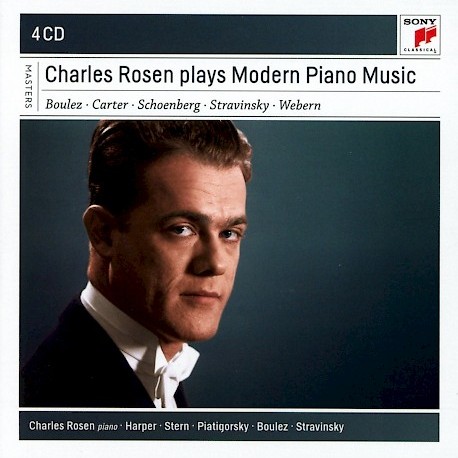
There is of course a middle way. The late American pianist and polymath Charles Rosen (1927-2012) shows us.
Despite his links to the great Romantic tradition of pianism (his teacher Moriz Rosenthal was a pupil of Franz Liszt), Rosen was equally committed to the most intense and cerebral music of his own time and was a great champion of the piano music of Elliott Carter in particular. (Try this at home: read Keats while listening to Carter’s Night Fantasies.)
Blessed with a phenomenal memory, Rosen was particularly adept at finding connections among different art forms such as music, literature and the visual arts; he also championed a flexible balance between tradition and innovation, as well as the equal and fundamental importance of old and new art to the broader community and culture.
He was also, in his wide-ranging essays, a marvellous and often witty stylist. Here he is in The Romantic Generation:
“Madness was an unpredictable form of inspiration. It had its own ritual of demonstration and its own methods of persuasion, a logic of the night and of dreams, in some ways as powerful and as convincing as the logic of the day.”
His final collection of essays, Freedom and the Arts (2012), has pride of place on my bookshelf.
But what does any of this have to do with our own writers and poets here in Western Australia? Quite a lot, actually.
Rosen insisted that to understand music in particular, and art and literature in general, one must take a historicist viewpoint, as well as engaging with it on many levels simultaneously. There is something of Vico in this, but let’s turn instead to Randolph Stow (incidentally, a gifted musician, too).
In The Merry-Go-Round in the Sea, Tourmaline and To the Islands, Stow drinks deeply from the wellspring of Western Australian landscape, history and mythology, while in Visitants and The Girl Green as Elderflower he taps sources further afield. Not as consciously “European” or modernist as Patrick White, Stow was nevertheless – and this is also true in his poetry – an innovator standing on the shoulders of giants.
One can see in the poetry of Tracy Ryan and John Kinsella, and indeed in the work of their son Tim Kinsella, not only the nourishment of tradition and the fond, fractious relationship to landscape but those multidisciplinary and cross-cultural comparisons so beloved of Rosen:
In my dream or something similar,
I played super-chess with Paul Klee
while Jacob Stirnemann’s clavichord
played away in the background.
Keys hit in the shape of Mozart’s Magic Flute.
In another world, Jean-Baptiste Oudry’s
Dogue combatant contre un cygne takes up
half of the clavichord’s interior.
The swan will escape in the nick of time.
But out there, birds fly, or try, finding their
own rhythm. As cities expand, the clavichords
of their soul shrink through something.
& it’s not Sonic Youth’s ‘Washing Machine’.
(From Tim Kinsella’s Super-chess & Clavichord)
However, it’s Kim Scott who perhaps best typifies Rosen’s ability not so much to balance as to hold in tension the competing aesthetic and moral claims of tradition and innovation in a more acculturational and postcolonial climate.
For if we think of works like Benang (“We are a people who have been lifted and blown by various winds, and yet we have always managed to find our ground.”), That Deadman Dance and Taboo, we find an essentially lyrical distillation of a rootedness in history whose trauma is undeniable, and of a contemporary, primarily written language enriched by traditional modes of oral storytelling.
Which illuminates another connection with Rosen: that fluency in a style means the ability to reproduce ad infinitum examples of that style. The very definition of extempore storytelling drawing on centuries of generative tradition. To fix such stories in print merely conceals their evanescent nature.