I see the cities of the earth, and make myself at random a part of them
Walt Whitman
In William Street, Kenneth Slessor writes: “You find this ugly, I find it lovely.” And yet by now – partly thanks to Baudelaire – we know an aesthetic appreciation of the urban environment depends less upon whether one finds it beautiful and more upon the flâneur’s apperception of the city’s physical decadence. One is more likely to find the city at once both ugly and lovely, contradiction rather than bivalence.
Of course, both terms imply value judgements and a subjectivity that is almost quaint. Yet having worked for a time in the construction industry and on the restoration of old houses, I have come to see “the skull beneath the skin” in a different light, the city’s building sites and derelict offices alike representing yet another contradiction: “I had seen birth and death,/But had thought they were different.”
Susan Stewart is surely right when she observes in The Ruins Lesson that “In a ruin, a formerly closed view will be opened to weather, light, earth, and sky, and our awareness of what was once present will be more acute because of its absence.”
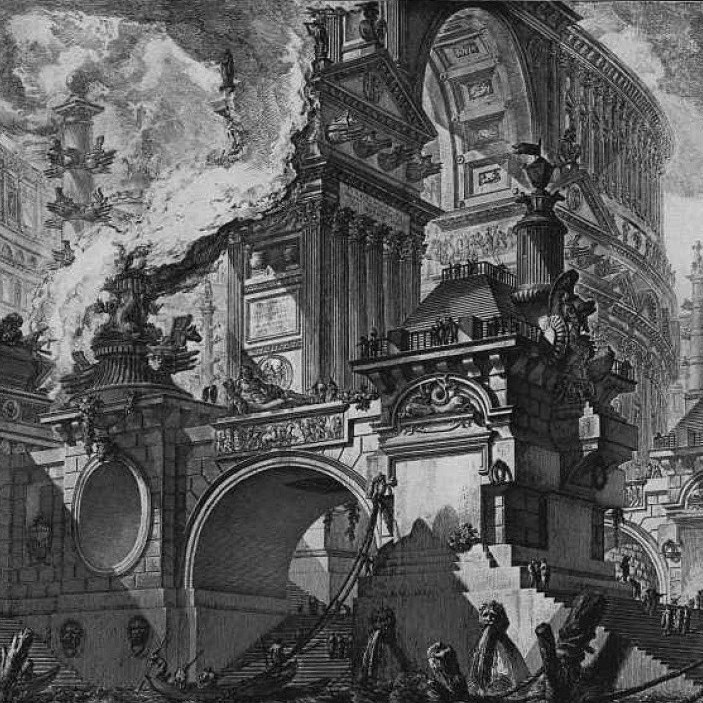
I think that poets are best placed not necessarily to fill or replace these absences, but to describe them – perhaps because they sense them more acutely. Or at least differently from the rest of us. One could imagine a Piranesi of the page constructing sonnets like carceri to shore against their ruins – and ours. Like Tracy Ryan’s Perth Girls, “They move through malls like whispers, unseen yet known.” Except the malls are our minds.
And who has not moved through city streets when the night has erased features subsequently illuminated by artificial means and undergoing a metamorphosis thereby into something richer and stranger? “Cities cannot see beyond their own light,” asserts Randolph Stow. Neither can we.
If, as Dorothy Hewett reveals, “Perth is a city built on sand and nostalgia,” it is not so much that the poem will outlast the city but that the former contains the latter – as an absence, a whisper.