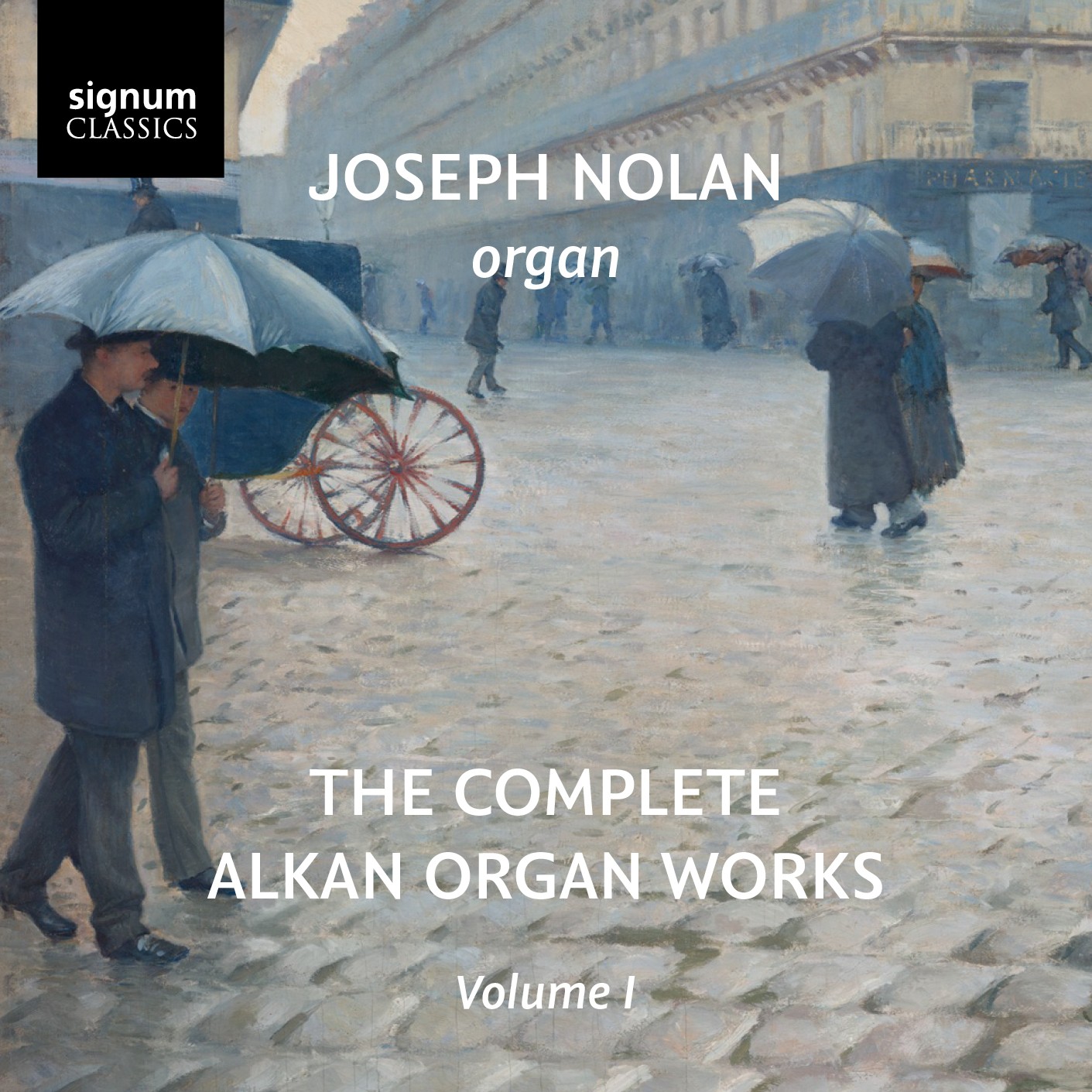
Signum Records SIGCD982. Released 13 March 2026
“It is hard to describe quite how thrilling the tutti of the Stahlhuth/Jann organ (in St Martin’s Church, Dudelange) sounds and feels in the first few seconds. Breathtaking doesn’t come close. However, it is not just the tutti that is special about this organ. There is a major arsenal of colour from pppp to ffff, which, when coupled with the perfect handing acoustic, elevates Alkan’s genius to the maximum.”
Thus writes British-Australian organist and conductor Joseph Nolan of the instrument used for his survey of Charles-Valentin Alkan’s complete organ works, of which this is the first volume. Listening to these extraordinary works, one understands not only why such an instrument is indispensable for doing justice to Alkan’s wildly original music, but also an artist of Nolan’s stature.
Alkan (1813-1888) was, like his contemporaries Chopin and Liszt, a pianist and composer of the first rank. He was arguably even more virtuosic and innovative than those two titans of the keyboard. It should therefore be acknowledged that the majority of the music one hears performed on the organ today was actually written for the pédalier, or pedal-piano – an instrument that integrated a full organ-style pedal board with the percussive and dynamic capabilities of the grand piano. Apparently, Alkan viewed it as the “ideal instrument”.
What we lose in translation is the delicate percussiveness and transparency of tone typical of the original Erard instruments; what we gain is the kind of orchestral grandeur, admitting of an almost infinite palette of colours and dynamic shading, that one hears here.
For this first volume, Nolan performs Alkan’s 11 Grands préludes et une transcription du Messie de Hændel, Op. 66; the Messiah transcription movements (Thy rebuke hath broken His heart and Behold, and see); the Petits préludes sur les huit gammes du plainchant; and the Impromptu sur le choral de Luther, Op. 69.
The principal point of comparison remains Kevin Bowyer’s survey on Toccata Classics and Nimbus – recordings of unquestionable historical importance, made at Blackburn Cathedral’s Walker organ and greeted upon release as revelations. Bowyer’s advocacy proved that these organ works were an essential part of the repertoire, and his mastery of the outlandish pedal writing, particularly in the Études pour les pieds seulement, left critics reaching for superlatives. One could not have wished for a more committed pioneer. And yet, placed beside Nolan, something becomes clear: Bowyer’s instrument, for all its magnificence, served the music as a brilliant hypothesis; Nolan’s serves it as a proof.
The eleven Grands préludes, Op. 66 illustrate the point vividly. These are pieces organised by constraint – chromatic key sequence, motivic economy, extreme brevity – yet their emotional range is stupendous. Critics have noted in particular the qualities of the seventh, Alla Giudeesca, with its synagogue-inflected modal arabesques, which sits in an organ loft and sounds like it belongs to a different civilisation entirely; and those of the tenth, which has elements of ribald Hasidic dance altogether alien to formal Christian worship. Nolan navigates these contradictions not by smoothing them over but by honouring their strangeness – his registrations are forensic, his sense of colour never deployed for mere effect. The Langsam of No. 9, that long arc of meditative stillness, achieves under his hands something close to what Simone Weil called attente – a waiting that is itself a form of prayer.
The Petits préludes sur les huit gammes du plainchant receive similarly precise attention. Each of these eight miniatures – traversing the medieval modes as a kind of compressed musicological journey – lasts barely a minute, yet Nolan brings to them the same concentration one brings to a page of Celan: nothing is throwaway, everything is load-bearing. The eighth, Moderato, with its quality of quiet isolation, emerges as a proto-minimalist meditation of considerable power.
The disc’s crown, however, is the Impromptu sur le choral de Luther, Op. 69. Alkan, a Jewish composer, takes Luther’s great fortress and subjects it to passacaglia, scherzo, siciliano, and fugue in succession, a construction at once architecturally severe and emotionally vertiginous. One can only agree with critic Norman Lebrecht: “Nolan is an organist with a mind of his own, and this record is in a class of its own”. The fugue’s closing pages, in Nolan’s hands, arrive with the force of something long suppressed finally breaking free – exhilarating, unsettling, and wholly unforgettable.
https://signumrecords.com/product/the-complete-alkan-organ-works-vol-1/SIGCD982