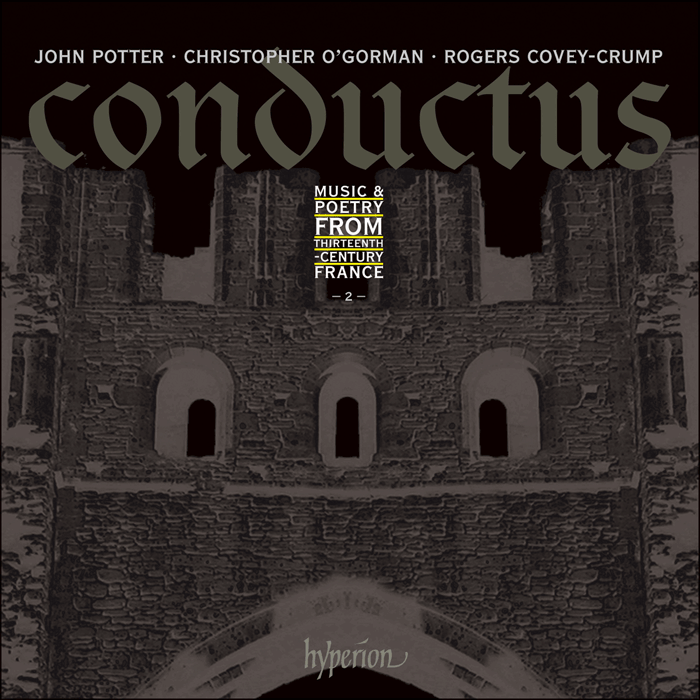
John Potter (tenor), Christopher O’Gorman (tenor), Rogers Covey-Crump (tenor)
Hyperion CDA67998. Released December 2013
This fascinating and beautiful release is the second in a three-volume series growing out of Cantum pulcriorem invenire: Thirteenth Century Music and Poetry, a University of Southampton-based project funded by the Arts & Humanities Research Council and led by Professor Mark Everist, whose extensive notes grace the accompanying booklets.
Again, tenors John Potter, Christopher O’Gorman and Rogers Covey-Crump are our guides through the mysterious realm of the medieval conductus, that ars antiqua genre of (mostly sacred) Latin song which flourished in Paris and elsewhere for nearly 100 years before being eclipsed by the motet in the second half of the 13th century.
I say “mostly” sacred, because among the themes and subjects treated by the poetry on this recording are (recent) history (Aurelianis civitas: the Orléans student riots of 1236) and the corruption of the papal court (Bulla fulminante, Quid ultra tibi facere and Dic, Christi veritas). Other conducti here tend towards the Marian (the lovely Ave Maria Salus hominum) and moralistic (Veste nuptial).
And again, the forms and textures vary: from mono- to multi-stanzaic poetry, from syllabic to melismatic settings, from monophonic to polyphonic textures, from measured to unmeasured rhythms and from using the same music for each stanza to a more through-composed approach. The French (Notre Dame) conducti are almost exclusively drawn from the so-called Florence manuscript of the mid-13th century (it’s housed in that city’s Laurentian Library); three English conducti come from, as Everist describes it, “a highly fragmentary manuscript now in the library of Worcester College, Oxford”.
The programme is bookended by an unmeasured and a measured version of Bulla fulminante, both sung solo by Potter. Though his readings are wry and dramatic (listen to the emphases on “Distrahitur” – “Torn apart” and “In spe vana plores” – “You will weep in vain hope”), the focus, here, as throughout, is on maximum clarity of diction and beauty of tone. And yet to hear the expansive three-part texture and florid caudae (melismas) of Ave, virga decoris incliti which follows the first version is to feel oneself immediately released from all care.
Other highlights in an impeccably performed and recorded programme include Potter and O’Gorman’s (monostanzaic) Celorum porta, Covey-Crump’s powerful Quid ultra tibi facere, the spare two-part Ave, tuos benedic with its extravagant attendant caudae and the superb three-part Dic, Christi veritas tutti, alive with dissonances, echoes and caudae.
Like the first volume, this second provides an utterly arresting glimpse on a world that seems so utterly alien to ours as to render it truly sacred.