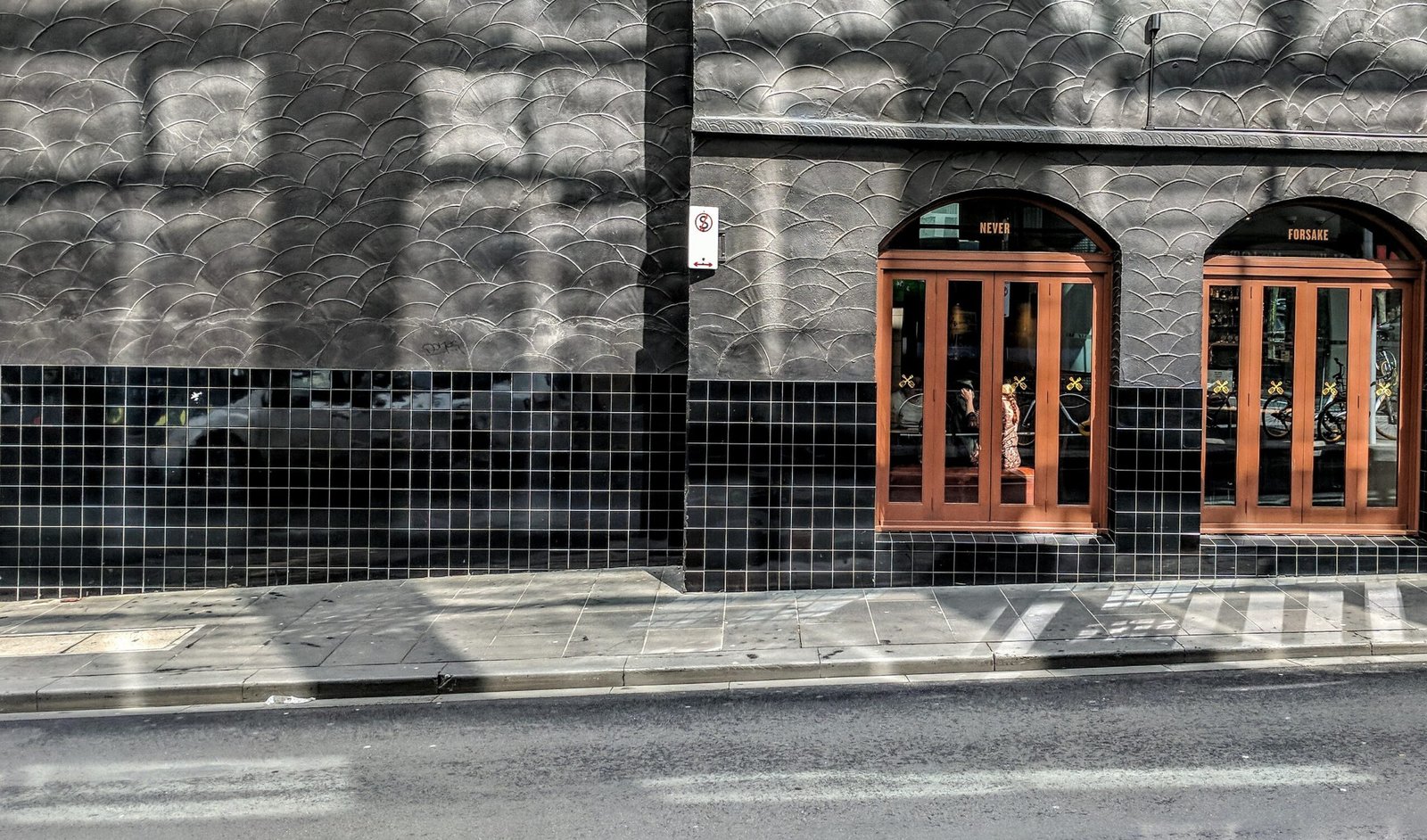
Melbourne (2017). Picture: Will Yeoman
IIf the mind is, as some say, truly an emergent property of the body, then we are already our own ghosts.
Such pleasant thoughts occurred to me while reading WA poet Liam Blackford’s latest collection of poetry.
As with Blackford’s previous collection, A Gateway Has Opened, each poem in No Freedom Too Total comprises six stanzas; each stanza, six lines; each line, six syllables. But be warned: Blackford’s poetry is a classic case of compressing highly combustible material. An explosion of the inevitable.
Lewis Turco would be proud of such a devotion to formalist rigour in a time where so-called free verse is, outside of the persistent vogue for appropriated forms such as the haiku, still the preferred mode of poetic expression.
Coincidentally, I had recently paid a visit to the excellent Sandra Black retrospective at the Art Gallery of WA. I was stuck by this WA ceramicist’s articulation of surface and form through highly expressive yet delicate piercing, carving, and colouring, as well as an integrity of design which admits of serendipity.
The otherwise completely unrelated work of Black and Blackford (!) recalls what Bachelard said about the house, that it shelters daydreaming: “The house protects the dreamer, the house allows one to dream in peace.” And that “Inhabited space transcends geometrical space.”
This leads me back to one of the great watersheds in poetic and musical history.
In the evolution of the 16th and early 17th century madrigal you can trace the movement away from a Renaissance classicism towards a Baroque expressionism; away from the so-called prima pratica of Palestrina, for example, towards the seconda pratica of composers such as Claudio Monteverdi, where, as he wrote, the often erotic text (usually by Petrarch, Ariosto, Tasso, Guarini and others) must be the mistress of the music, not its handmaiden.
This also meant a gradual shift from an arguably opaquer polyphonic texture, usually for five unaccompanied voices, towards one featuring solo voice or duet with instrument accompaniment.
Among that of his predecessors and contemporaries – the finest of which included Rore, Marenzio, Willaert, Wert, Gesualdo, Monte, Andre Gabrieli and Luzzaschi – Monteverdi’s music best illustrates this evolution, and these nine books, published between 1587 and 1651, comprise a crash-course in the art of the madrigal as practiced either side of the turn of the century.
Taken in isolation, the madrigal – a musical setting of a poetic text originally sung by unaccompanied vocal consort, one voice to a part – is emblematic of Monteverdi’s prodigious genius, as well as his obsession with placing greater and greater store on the primacy of said texts. Which was only going to end one way.
Although you can track the changes in style from Monteverdi’s Book 3 (Il terzo libro de’ madrigali, 1592) onwards, the big moment comes with 1619’s Book 7 – to give it its full title, Concerto. settimo libro de’ madrigali a 1. 2. 3. 4. & sei voci, con altri generi de canti.
Here, the polyphonic madrigal is finally replaced by solos, duets, trios, quartets and sextets with sometimes sparse, sometimes rich instrumental accompaniments and a more dramatic, declamatory approach to word-setting. Not only that; rather than a collection of thematically unrelated madrigals, we have a more structured, narrative intent.
In other words, Monteverdi has already sailed into operatic realms, even if he would not have recognised them as such. His eighth and final collection (discounting the posthumous 9^th^ book of madrigals), Ottavo libro de’ madrigali, Madrigali guerrieri, et amorosi, published in 1638, went even further. It is, arguably, the madrigal’s apotheosis.
So, to get to the point: for Black, Blackford, Monteverdi and all those other artists who submit to the rigors of form in order to transcend it, it’s a recognition that the Apollonian vs Dionysian, Classical vs Romantic thing is not really a thing at all. Expressive affect is an emergent property of strict form. Miasmic or mellifluous, one is the ghost of the other.