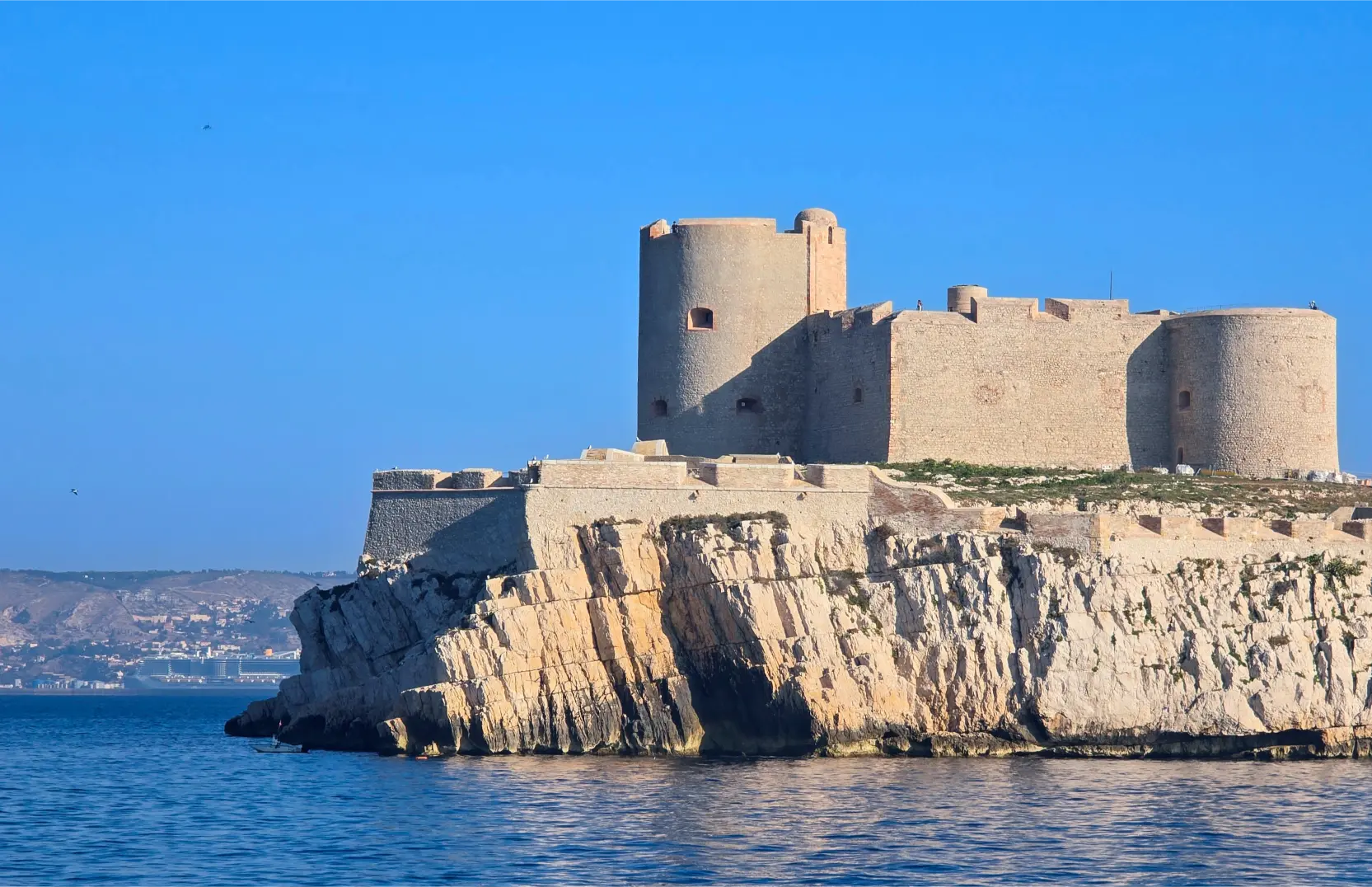
Château d’If (2025). Picture: Will Yeoman
Le voyageur s’arrête, et la cloche Rustique, aux derniers bruits du jour mêle de saints concerts...
A nocturne maybe, tinkling in the distance, or clinking glasses as the bistros fill. Perhaps you looked out over this same view of the Vieux-Port, with George at your shoulder. You’d only been together for a year: many still to come, not many happy. I like to think you loved the bobbing barks as much as I do on this autumn evening. Some years before, Alphonse penned poems here. Or maybe not. In any case, time’s swept away all words, the endless night persisting like a nocturne in the distance or glasses overflowing not with wine but semiquavers tumbling over chords.
Having heard the tales of Huguenots and Dumas’ fictional Count imprisoned there, we sail from Vieux-Port to Château d’If, that brittle limestone white against the blue. From 16th century fortress to a prison preserving class distinctions in its structure, today the Château mostly trades in tourism. From Frioul Archipelago to cells and stairs my focus turns, my hands on old inscriptions carved in the cold stone: it’s like reading braille. Back outside, walking battlements, I see back on the mainland, beautiful la Bonne Mère. I’m reminded that the archipelago is part of the Calanques National Park, another part of which we visited, on another day much like this bright day. Echoes, too, of Fort Saint-Jean, late sailed by. I once read somewhere that, in 1516, Francis I came here to see a marvel : a rhinoceros, destined for the Pope, making a strange but scheduled stop en route. If there could be a kinship felt between this gentle, lonely beast and prisoners still far off on some future If, well that’s a big if. And yet I like to think so, for what binds us more than chains or coarse rope to each other is a longing for home.
Since Thomas Blood was pardoned by the king for trying to make off with the Crown Jewels, it seems a small imposture to act tourist and cross the Liberties in search of wealth. I mean knowledge, of course (may course the Thames until I end my song). The White Tower will keep another 1000 years but not so Will. I love the Gherkin, Shard and Tower Bridge nearby, and inside gleaming armour ranged in patterns putting the jewels in the shade. The walls of Henry III and Edward I essential for Mint and Armouries alike. But what about abounding shades within? Sad Edward V and brother, disappeared. Anne Boleyn, Catherine Howard and Jane Grey. Inside St John’s Chapel, beneath barrel vaulting, I sit and meditate on all these things, while trying to imagine former richness, the 13th-century stained glass, cross of gold. The women come and go, the children play. Outside, the ravens’ black throws beefeaters’ blood red into relief. Relieved, I step out into a London winter, Romanesque and proud Londinium fading like a dream. I stand and watch the Thames then turn to see hordes of tourists queuing up to enter the London landmark I’m grateful to have left.
Where Eden, Caldew and smooth Petteril meet, Sits England’s northmost city: Cumbrian Carlisle. The Scottish border’s close; while within reach, The Solway Firth, the Pennines and the Lakes. A border buffer born of Roman need, its evolution defied a soggy climate through medieval and Victorian times. Today, Carlisle’s museum, Tullie, tells the story of old Luguvalium, a military hub for Hadrian’s Wall, and of the flourishing town with this stern heart, and of the timber forts replaced by stone. The original Roman grid survived what came, the land a palimpsest of war and trade. Norman Carlisle Castle, much besieged. Norman Carlisle Cathedral, once proud priory. The Border Reivers with their broken men, Debatable Lands allowing lawlessness. Then peace and the Industrial Revolution, Carlisle’s Citadel Station rising triumphant. All this I later learn, but while still there, absorbed the chilly autumn atmosphere as a stranger from an even stranger land. A piece of Owen Jones’ cathedral ceiling lives in our drawer, a blue star-studded tea towel that sparks more modest memories of the visit. The baps enjoyed at the cathedral’s cloister café. Discovering Tullie’s Pre-Raphaelite paintings. Seeing youths make mischief in the mall. Admiring a small dog on an old man’s lap.