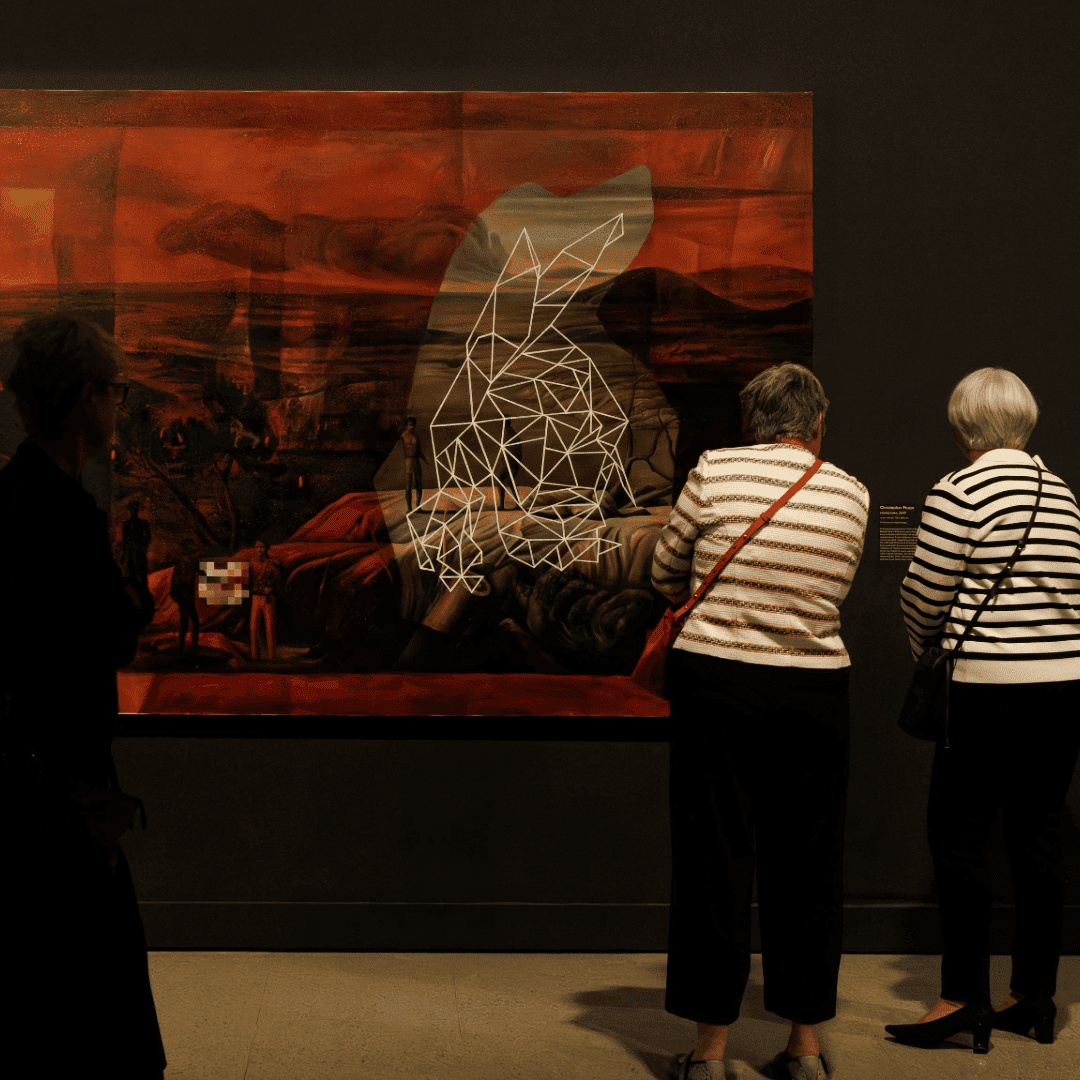
In the Australian colony’s self-portrait, the land was a tabula rasa on which history was waiting to be written. Even among the earliest settler lithographs and aquatints, the new Eden’s topography is depicted with barely concealed avarice, the original inhabitants for the most part reduced to mere ornamental staffage – handy for indicating scale but hardly signifiers of a complex, sovereign civilisation. Born in Perth in 1969, Minang/Wardandi/Bibbulmun man Christopher Pease has spent decades painting his way out of this “land belonging to nobody” (“terra nullius”) fiction. Terra Nullius, his major survey exhibition at John Curtin Gallery, is the most concentrated and forceful reckoning with that project to date.
One of Pease’s chief organisational principles is the idea of the palimpsest – originally, a page of parchment or vellum whose original writing had been scraped away ready for reuse, but whose previous markings were always visible beneath the new content. Pease paints a painterly copy of a colonial image – perhaps a lithograph after Louis Auguste de Sainson, an aquatint derived from Robert Dale or an engraving by Cruikshank – then paints over it.
Just as colonial history and power structures persist beneath the surface of contemporary Australia, the source material persists beneath superimposed targets, floor plans and topographical lines. This dissonant dialectic, this cacophonic counterpoint between the European utopia below and the Noongar commentary above, is the engine driving the whirring gears of the whole exhibition.
Read the full review at Seesaw