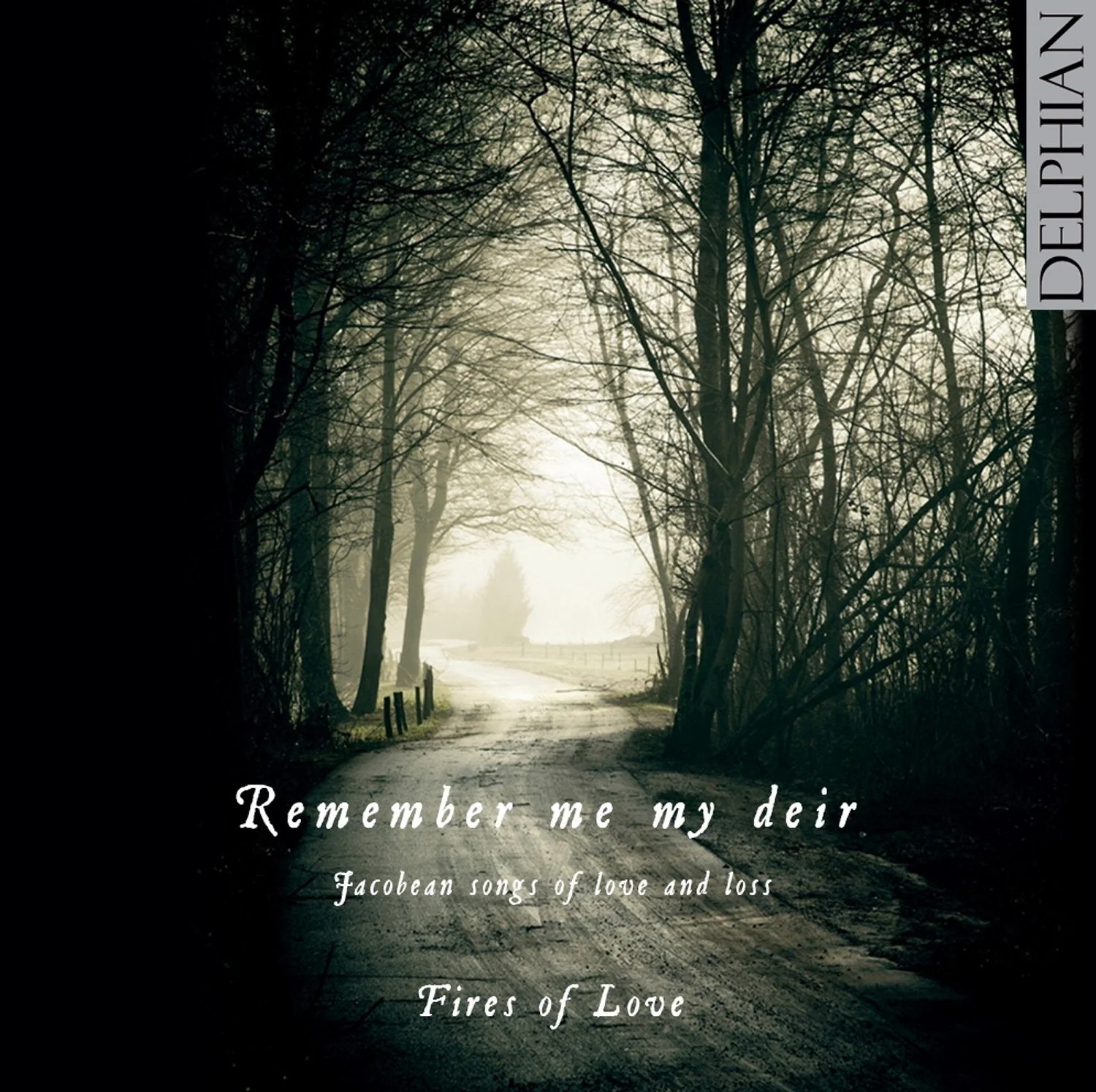
Delphian DCD34129. Released 9th December 2013
After the very fine Chansons a Plaisir: Music from the time of Adrian le Roy and Love and Reconquest: Music from Renaissance Spain comes Scottish early music ensemble Fires of Love’s Remember me my deir. Here, the focus is on both the music associated with King James VI of Scotland and the music he might have encountered in England upon his becoming King James I of that country in 1603. Consequently, this program contains an attractive mix of Scottish music with a French accent and English music with an Italian accent.
What hasn’t changed is Fires of Love’s intelligent approach to programming and interpretation. The musical journey begins and ends with different versions of the haunting And will he not come again – the first accompanied only by the barely audible stirrings of Ferries’ Renaissance guitar, the second, sung to a melody based on Mad Tom of Bedlam, featuring both guitar and lute – the extremely versatile recorder player Jonathan Hugh-Jones plays the second lute on many of the tracks, and even sings baritone on one – as well as percussion.
In between is a selection of Scottish and English songs and instrumental pieces performed in a variety of arrangements and from a variety of sources. From the Straloch manuscript there are lute solos such as the very politically incorrectly named I long for thy virginite; the Rowallan, Braye and Jane Pickeringe manuscripts also yield many lute and guitar pieces, such as the lute duet The Scottish Huntsupe and the Pavane (Passamezzo) and Gagliarda.
And while much pleasure is also derived from songs both gay and melancholy such as O sweet Oliver – My bonny lass and Remember me, my deir, which feature the full ensemble of percussion, recorder, guitar and voice, some of the most pure, refined performances are those involving just voice with a simple guitar or lute accompaniment. Among my favourites are Francis Pilkington’s well-known Rest, sweet nymphs and the exquisite The cypress curtain of the night by Thomas Campion, which at just over six minutes is also the longest item in the program – hardly a cause for complaint.
Here as throughout, soprano Frances Cooper proves the most able and beguiling of interpreters, her diction crystal-clear, her voice sweet and steady, her expression attuned to the subtlest affective potential of both music and the poetry. Ferries, as on any of his numerous solo recordings, is a relentless exploiter of the percussive and cantabile qualities of plucked strings, while Marcus Claridge and Hugh-Jones divide those qualities admirably between them, as befits their respective instruments. Together, the blending of timbres and tone colours is nothing short of perfect.